



REVESCO. Revista de Estudios Cooperativos. ARTÍCULOS
e-ISSN: 1985-8031
Emmanuel Muzigirwa Muke
Universidad de
Valladolid (España) 

Carmen Rodríguez Sumaza
Universidad de
Valladolid (España)
Juan José Juste Carrión
Universidad de
Valladolid (España)
https://dx.doi.org/10.5209/REVE.97313 Recibido: 09/01/2024 • Aceptado: 22/07/2024 • Publicado: 05/08/2024
ES Resumen. Este estudio pretende identificar los factores endógenos y exógenos que influyen en la decisión de los pequeños hogares productores de café de afiliarse a las cooperativas agrícolas de café en Kivu del Sur, una provincia conflictiva del este de la República Democrática del Congo (RDC).
Tras una prueba piloto, se recopilaron datos mediante una encuesta transversal, en los territorios de Kabare, Kalehe e Idjwi en la que participaron 412 pequeños productores de café miembros y no miembros de cooperativas de café, seleccionados al azar. Se observó representatividad geográfica en la distribución de esta muestra en los tres territorios. Se aplicó un modelo logit para determinar los principales factores de afiliación.
En un contexto de conflicto como el este de la RDC, la confianza en los líderes e iniciadores de una cooperativa agrícola, la necesidad de un pequeño hogar cafetero de construir su capital social a través de la cooperativa y su percepción de la adecuación del beneficio económico (dividendos) a recibir son los factores más significativos en la decisión de afiliarse o permanecer en una cooperativa agrícola. Otros factores como la edad del cabeza de familia, la necesidad de un pequeño hogar cafetero de acceder a insumos agrícolas y formación técnica y la distancia entre su plantación y la estación de lavado de café más cercana también tienen un efecto significativo en la decisión de unirse a una cooperativa cafetera en el este de la RDC.
Los resultados de este estudio ayudan a comprender la dinámica del desarrollo rural y la gestión de las cooperativas agrícolas en un contexto socioeconómico difícil, como el del este de la RDC. Los hallazgos también tienen implicaciones para las acciones, estrategias y políticas públicas que deben adoptar las cooperativas, los actores del desarrollo del sistema de mercado y el gobierno, con el fin de promover la cohesión social y mejorar las condiciones de vida de la población rural a través de las cooperativas agrícolas.
Palabras clave. Pequeño productor de café, cooperativas agrícolas, regresión Logit, República Democrática del Congo.
Claves Econlit. O13, Q13, P13, P25.
ENG Determinants of membership to agricultural cooperatives in eastern Democratic Republic of Congo: An exploratory study of the coffee sector in South Kivu province
ENG Abstract. This study identifies the endogenous and exogenous factors that influence whether small coffee-growing households decide to join agricultural cooperatives in South Kivu, a conflict-prone province in the eastern Democratic Republic of Congo (DRC).
After a pilot test, data were collected through a cross-sectional survey in the territories of Kabare, Kalehe and Idjwi, and 412 randomly selected small coffee producers, coffee cooperative members and non-members participated in the survey. Geographical representativeness was observed in the distribution of this sample across the three territories. A logit model was applied to determine the main factors of membership.
In a challenging context such as the eastern DRC, trust in the leaders and initiators of an agricultural cooperative, the need for small coffee-growing households to build up social capital through the cooperative and the household’s perception of the adequacy of the economic benefits (dividends) to be received were the most significant factors in the decision to join or remain in an agricultural cooperative. Other factors such as the age of the household head, the household’s need to access to agricultural inputs and technical training, and the distance between the plantation and the nearest coffee washing station also had a significant effect on the decision to join a coffee cooperative in the eastern DRC. The results of this study help to clarify the dynamics of rural development and the management of agricultural cooperatives in difficult socioeconomic contexts, such as the eastern DRC. The findings also have implications for actions, strategies and public policies to be adopted by cooperatives, market system development actors and the government to promote social cohesion and improve the living conditions of the rural population through agricultural cooperatives.
Keywords. Coffee smallholder, agricultural cooperatives, Logit regression, Democratic Republic of Congo.
Summary. 1. Introduction. 2. Methodology. 3. Results. 4. Discussion and conclusions. 5. References.
How to cite: Muzigirwa Muke, E.; Rodríguez Sumaza, C. & Juste Carrión, J.J. (2024). Determinants of membership to agricultural cooperatives in eastern Democratic Republic of Congo: An exploratory study of the coffee sector in South Kivu province. REVESCO. Revista de Estudios Cooperativos, 147(1), 1-15, e97313. https://dx.doi.org/10.5209/REVE.97313.
This introductory section is divided into two parts. The first part sets out the theoretical background and objectives of the study, while the second contextualises the study in the Democratic Republic of Congo (DRC).
1.1. Theoretical background and objectives of the study
Numerous studies exist on why farmers join cooperatives across various value chains globally. Among the factors that can influence membership of an agricultural cooperative, Idrissa et al. (2007) and Woldu et al. (2015) distinguish those that are endogenous for the small producer or his household and those that are exogenous. Msimango and Oladele (2013) point out that farmers decide to form or participate in agricultural cooperatives to overcome barriers such as poverty, market failures, missing services, lower incomes, high transaction costs with traders and the need for contributions to community development. Agricultural cooperatives also help to improve productivity through access to resources and management skills, thanks to their strong links with agricultural and technology extension agencies. This enables them to buy seed, sell grain or even assist with marketing efforts. Cooperatives can thus improve the profits and standards of living among their members. By deciding to set up and/or join an agricultural cooperative, small-scale producers are pursuing several interconnected socioeconomic objectives: They pool their resources and increase their bargaining power on the market (Fulton & Hueth, 2009) with a view to generating income, reducing their poverty (Ahmed & Mesfin, 2017; Habtamu, 2021; Sentime, 2019; Verhofstadt & Maertens, 2015) and promoting local development (Khumalo, 2014).
Without specifically addressing the case of conflict zones, several empirical studies have been conducted in Africa on the determinants of smallholder membership of agricultural cooperatives. In Ethiopia, Bizualem and Saron (2018) found that the need to access credit and agricultural inputs, farmers’ perception of the adequacy of shared dividends, trust in cooperative management and the need to access training and markets through cooperatives are significant determinants of membership. In the Bench Maji zone of south-western Ethiopia, Debeb and Haile (2016) found that level of education, information/media access, marketing and support from cooperative promotion offices, farmers’ attitude towards cooperatives, leadership commitment and trust among members and management committee statistically and significantly influenced farmers’ cooperative membership. Mojo, Fischer and Degefa (2015) found that the probability of farmers deciding to join a cooperative increase with age, education level, family size and land property. In Northern Ethiopia, Nugusse, Huylenbroeck and Buysse (2013) found that information access, special skills, membership in rural associations, frequency of attendance at public meetings/workshops, education level of the household head, access to credit and training, number of family members in school, distance to the main market, availability of infrastructure, farmland ownership and farmland sizes were the major explanatory variables statistically influencing whether rural people join cooperative societies. Mbagwu (2018) showed, meanwhile that age, farming experience, income, household size and poverty level influenced cooperative membership in Abia state, Nigeria.
For Rwanda, Mugabekazi (2014) showed that factors such as distance to the cooperative washing station, age of the household head, access to credit, experience in growing coffee, quantity of coffee produced and household size were statistically significant factors influencing membership in the coffee cooperative in Huye district. Gasana (2011) revealed that need to access markets and agro-veterinary services, access to training opportunities and the need to work with others explained the decision of farmers to join cooperatives. The study also reported that being unable to afford membership fees, the poor performance of the cooperatives and lack of awareness about cooperatives were reasons for not joining.
Most of these studies were carried out in stable contexts and with a quantitative approach. Thus, mixed approaches studies, particularly in conflict zones, remain elusive. This raises the question: Are the determinants similar in these regions? This research sought to establish the determinants of membership in agricultural cooperatives in the eastern DRC, an area frequently affected by conflicts. It is important to recognise that farmers’ behaviour is not homogeneous across different geographical and contextual environments. This study therefore sought to provide nuanced insights specific to this unique and challenging context, with a focus on Kabare, Kalehe and Idjwi territories, in South Kivu, a conflict area with a difficult socioeconomic environment.
1.2. Cooperatives and the coffee sector in the DRC
As in most African countries, the modern Congolese cooperative movement originated in colonisation. Develtere (2009) notes that in the Belgian-Congo and the territory then known as Rwanda-Urundi, indigenous people were allowed to set up their own cooperatives as early as the 1920s. Mahaniah (1992) and Sebisogo (1993) consider 1921 to be the year when cooperatives first obtained legal status in the DRC on the basis of the decree of 23 March, which, however, prohibited Congolese nationals from forming cooperatives.
There were several cooperatives during the colonial period, and most of them were agricultural (Sentime, 2019). Among the dozen or so agricultural cooperatives in existence at the time was the Coopérative des Producteurs Indigènes de Café (COOPROCAFE), which was founded in 1950. This Belgian-run cooperative was responsible for producing and marketing coffee (Kakule, 2015). Marketing was disciplined, as farmers could only sell their coffee to the cooperative. During this period, the colonial administration officially justified the creation of indigenous cooperatives for reasons related to the improvement of the living conditions of small producers (Mokili, 1998; Sebisogo, 1993). Cooperatives remained, however, an integral part of the country’s exploitation strategy, especially for coffee and other export- oriented industrial crops, such as cotton and rubber (Ndongala, 1966; Sebisogo, 1993). Farmers could only sell their products to the cooperative, whose managers were mainly Belgians. These first cooperatives were not concerned with the education and training of Congolese (Kamwanya, 1993).
The decree of 24 March 1956 corrected the shortcomings of the decree of 16 August 1949 by abolishing the colonial administration’s high level of supervision over the cooperatives (Develtere, 2009; Sebisogo, 1993). Although strongly criticised by numerous authors and development actors, who considered it inadequate to the national development needs, this new decree remains the benchmark for cooperatives in the DRC to this day (Kamwanya, 1993; Sebisogo, 1993). Since the DRC joined OHADA in 2010, this reference framework has been supplemented by the Uniform Act of 15 December 2010 on the law governing cooperative companies. After independence (1960), these “indigenous” organisations managed by Europeans fell into decline – with the exception of savings and credit cooperatives (Develtere, 1992; Kamwanya, 1993; Sebisogo, 2017) – because of the lack of honest and qualified managers, strong concerns about members’ understanding of the cooperative philosophy and their participation as cooperators, managers’ concerns about governance and the departure of the missionaries who were supporting them, among other reasons. This decline was also reinforced by the more than decade-long socioeconomic and political crisis in the DRC. In the 1990s, against a backdrop of violence and armed conflict in eastern DRC, local communities, mainly farmers, continued to organise themselves into peasant organisations and solidarity groups to combat poverty. These community initiatives have, however, faced numerous constraints, including access to remunerative markets and inputs, as well as low levels of professionalisation, among others.
In the process of rebuilding peace and development, agricultural cooperatives were revived and supported by non-governmental organisations to combat poverty among small rural producers through inclusive agricultural market systems development (MSD) interventions. Coffee remains one of the most exported crops in South Kivu, so its value chain has been the most targeted by MSD interventions. At present, there are some 30 agricultural coffee cooperatives that collect coffee in the province and sell it abroad. Coffee has long been the leading export product in the Congolese agricultural economy. In the 1980s, coffee export was the second most lucrative after copper in the DRC (Dowinie, 2018). It was a large-scale cash crop during the colonial period but declined during Mobutu’s reign; in the 1980s, Congo exported an annual average of 88,000 tonnes of coffee (Dowinie, 2017), but in 2016, the quantity exported was only 8,000 tonnes (Kambale, 2017).
Despite all its sociopolitical challenges, the DRC has an ideal coffee-growing climate and hilly terrain making it a haven for Arabica and Robusta coffee (13 and 87% respectively) (Common Fund for Commodities [CFC], International Coffee Organization [ICO] and World Bank, 2000). In eastern DRC, the coffee value chain contributes to main source of household income, despite being among the least consumed crops in the country. Coffee is worth several million US dollars to small producer households and to the province of South Kivu, which exports at least 1,000 tonnes of coffee each year, produced mainly by thousands of small, scattered producers. Grown on the shores of Lake Kivu and at high altitudes, it is essentially organic, giving it a unique taste and flavour highly prized internationally. The coffee value chain in the province involves several formal and informal players with different interests. High informal taxes have driven value chain players to smuggle coffee into neighbouring countries. With the socio-political crisis, the war of the 1990s in eastern DRC and other structural factors mentioned above, coffee production continued to decline. Many small growers abandoned the crop in South Kivu, although the province is well known as producer of specialty Arabica coffee, unlike Robusta, which is more common.
The coffee value chain in South Kivu has seen improvements in its market system in recent years – and in the context of peacebuilding – which have created opportunities for development through the emergence of agricultural cooperatives, the rejuvenation of plantations, the adoption of good agricultural practices through farmer training institutes and the organisation and participation of cooperatives in agricultural product forums and events. Agricultural coffee cooperatives have been established to improve productivity and market access; these are viewed as instruments for combating poverty in rural areas (Birchall, 2003) and a prerequisite for sustainable success in the fight against widespread and multidimensional poverty (ILO/ICA, 2003; Wanyama et al., 2008; Zeuli & Radel, 2005).
It is against this background that supporting inclusive agricultural Market Systems Development (MSD)[1] in developing countries encourages the creation and development of agricultural cooperatives to increase agricultural production, trade and markets (Barrett, 2011; DFID, 2005b; Social Impact, 2015). In the province of South Kivu, where coffee is mainly produced by small, geographically dispersed farmers (Development Solutions, 2014), all MSD interventions implemented over the last 10 years[2] in Kalehe, Idjwi and Kabare territories have focused on a socioeconomic model with four key players: the government; the cooperative sector; the non-profit sector (cooperation agencies, non-governmental organisations); and the private sector. With the assistance of international non-governmental organisations, international buyers such as Starbucks, Country Culture, Twin and Nespresso have increased their interested in coffee from these three regions, which has resulted in the proliferation of diverse agricultural cooperatives of small-scale coffee producers (Bayan Global, 2019). Several cooperatives – new to the coffee business and without sufficient equity capital – have receive pre-financing from Starbucks via local banks to deliver their parchment coffees to COFFEELAC. For their members, these cooperatives act as buyers/commission agents of fully washed coffees for Starbucks via COFFEELAC and Falcon. They derive substantial benefits from running their offices, although little for the cooperative members, despite the organic and coffee practices certifications. Slosse, Buysse, Schoors, Godfroid, Boyen and D’Haese (2022) have also pointed out that sustainability certifications have been introduced into coffee growing via these cooperatives in the east of the DRC. Certified cooperatives enable coffee producers to access markets and cushion price falls. Labels such as Café Femmes, Café Genre and specific approaches such as the Gender Action Learning System are being developed to increase the participation and involvement of women.
Some cooperatives – including SOPACDI, Muungano in Kalehe, RAEK in Kabare and SPCNCK in Idjwi – have successfully found international buyers and sell green coffee after processing in factories in Goma. Others, like Tumaini Coffee in Kavumu, CPCK/Kabamba, KACCO, CCKA and COCAI export directly. Virunga Coffee is one of these; it is a subsidiary of Café Africa, which is associated with OLAM, a Singapore-based multinational that combines private and public initiatives from several member countries. That explains why cooperatives are perceived as organisational arrangements offering viable business alternatives and have significant potential for poverty alleviation (Birchall & Simmons, 2009; DFID, 2005a, 2009; Spear, 2010). They excel in identifying economic opportunities to empower the disadvantaged, providing security for the poor by converting individual risks into collective risks (Wanyama et al., 2008), promoting small farmers’ market participation, generating income and reducing poverty (Develtere, Huyse and Ongevalle, 2021; Kamwanya, 1993; Sebisogo, 2017; Sentime, 2019). They also enhance the bargaining power of small producers in the market, supply and distribute agricultural products, and provide services such as storage and transport, thereby facilitating market access for their members. Cooperatives thus play a crucial role in linking smallholders to markets and devising strategies for promoting local and rural development (Ahmed & Mesfin, 2017; Habtamu, 2021; Verhofstadt & Maertens, 2015). In the DRC, many authors such as Ndongala (1966), Kamwanya (1993), Sebisogo (2017) and Develtere et al. (2021) have also advocated cooperatives as a solution to the country’s poverty and underdevelopment.
Despite the profusion of coffee cooperatives in South Kivu and their perceived role in combating poverty among their members, some small coffee producers remain reluctant to join. At the time of this research, no independent study had been conducted to address this gap. This study fills this gap and assists stakeholders in understanding the dynamics of rural development and agricultural cooperative management in challenging socioeconomic environments such as that of the eastern DRC.
This section presents the adapted analysis model for this study, the data collection sources, and the sampling and the process for selecting the specific variables included in the model.
2.1. The analysis model
Membership in a cooperative for a small coffee producer in South Kivu, as evidenced by the possession of a membership card, is free and voluntary. Participants were required to be a member of at least one agricultural cooperative of coffee growers operating in the study zone. The rationality of a small coffee producer’s decision to join a cooperative is based on a hypothesis of maximisation of expected utility under certain conditions (Cooper, 1997). When faced with a choice between two alternatives (joining or not joining), the small producer compares the expected utility of joining the cooperative with that of not joining. Thus, he will only decide to join a coffee cooperative if and only if the resulting utility is greater than that of not joining.
Suppose Y is the membership decision, which we code Cooperative_membership: it takes the value 1 (Y=1) if the small coffee producer chooses to be a member of a cooperative, and 0 (Y=0) if he/she chooses not to be a member. The decision to join a cooperative (Y) is influenced by several endogenous and exogenous factors. Endogenous factors include the characteristics of the household or the household head, socioeconomic and technical needs, attitudes and confidence of the household head in cooperatives, among others. Exogenous factors include the characteristics of the small producer’s plantation, but also the features of the cooperatives and how they operate, which are related to objective elements of the cooperative’s governance, its geographical area, the size and quality of its income and its members, the additional services offered to its members and its history, among other aspects.
The decision to join a cooperative is the variable explained. A small coffee producer, rationally speaking, would decide to join a cooperative only if his utility is maximised by membership. Thus, the expected utility of joining and not joining a cooperative for a small farmer j can be expressed as follows:


where
 and
and  denote,
respectively, the expected utility of non-membership and membership in the
cooperative. X represents the different demographic and socioeconomic
characteristics of a coffee farmer j, his farm and his personal
perceptions (attitudes) about coffee cooperatives. Note that
denote,
respectively, the expected utility of non-membership and membership in the
cooperative. X represents the different demographic and socioeconomic
characteristics of a coffee farmer j, his farm and his personal
perceptions (attitudes) about coffee cooperatives. Note that  is a
random disturbance and is assumed to be independently and identically
distributed with a zero average. The difference in the utility expected by
small farmer j can thus be written as:
is a
random disturbance and is assumed to be independently and identically
distributed with a zero average. The difference in the utility expected by
small farmer j can thus be written as:



If  , the
small producer should prefer to participate in the cooperative organisation.
Thus, the difference in expected utility between participation and
non-participation is the potential factor influencing the decision. The
decision to join (Y) a cooperative remains the key variable of this analysis
model. This is expressed as follows:
, the
small producer should prefer to participate in the cooperative organisation.
Thus, the difference in expected utility between participation and
non-participation is the potential factor influencing the decision. The
decision to join (Y) a cooperative remains the key variable of this analysis
model. This is expressed as follows:
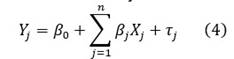
 (5)
(5)
 (6)
(6)
Although the decision to join is a dichotomous variable, Hurlin (2003) and Greene and Hensher (2010) agree that ordinary linear regression such as the ordinary least squares model does not guarantee a good result for this type of study, and the choice should be between the logit and the probit methods.
These two dichotomous models admit as the explained variable not a quantitative coding associated with the occurrence of an event (as in the case of linear specification), but its probability of occurrence, which is conditional on the exogenous variables. A qualitative random variable is described by the probabilities of the different attributes it can take on, which are subject to modelling. This modelling makes it possible to quantify the influence of different variables on whether a small farmer joins a cooperative enterprise. Analysis of the normality of data distribution was carried out using three tests: Jarque–Bera test, Kurtosis test and the coefficient of asymmetry. These tests allowed us to confirm that the residual distribution does not follow the normal distribution and to use the logit model. Given the multiplicity of explanatory variables, we now specify the criteria for selecting those that are relevant and will be retained in the analysis.
2.2. Data sources, sample and collection methods
Small coffee producers, both members and non-members of cooperatives, are the main sources of data for this study; these are estimated to comprise at least 26,304 households (IPAGRI, 2019). These households do not have the same size as a plantation, and they coexist with modern plantations owned by large concessionaires (companies). The small producer members of the cooperatives that took part in the survey came from 17 different coffee cooperatives, each with at least 500 members. It should be noted that the identified cooperatives facilitate the certification of their members, which also facilitates international sales.[3] This study was carried out in the DRC, in the province of South Kivu, along the coast in Kabare, Kalehe and Idjwi territories, as shown in Figure 1.
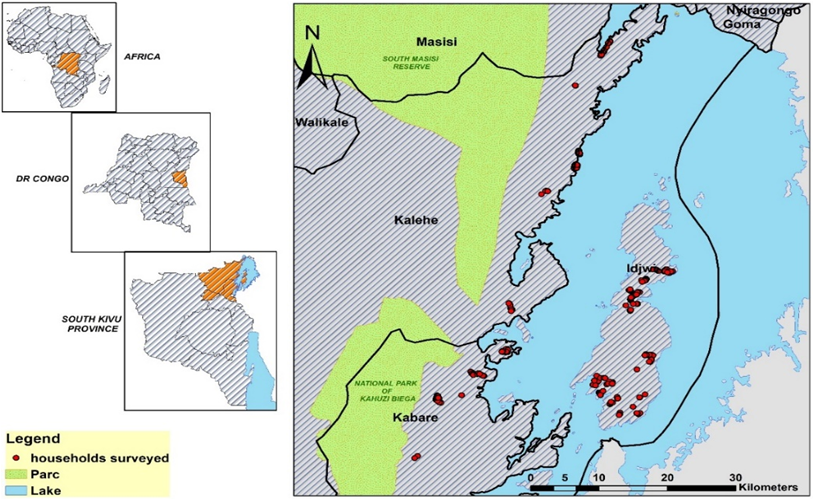
Figure 1: Map of the study area.
The interviewers received methodological and ethical training before the start of data collection, and the collection tools had also been pilot-tested to ensure that the questions were clear and respected the local culture. Once in the village, the interviewers went to the coffee washing station (where there was one) or to recognised coffee-producing villages to begin data collection. A sampling step of at least 5 households was observed for non-cooperative members based on the density of each zone. For cooperative members, a random sub-sample of members to be surveyed was drawn up based on lists received at the local level.
Table 1. Respondents and their territorial distribution
|
Territory |
Status in coffee cooperatives |
% |
||
|
Members |
Non-Members |
TOTAL |
||
|
Idjwi |
60 |
81 |
141 |
34% |
|
Kabare |
31 |
92 |
123 |
30% |
|
Kalehe |
62 |
86 |
148 |
36% |
|
TOTAL |
153 |
259 |
412 |
100% |
|
% |
37% |
63% |
100% |
|
Source: Own elaboration.
To complement the quantitative survey, a qualitative approach was used, with selective sampling for interviews and focus groups targeting cooperative managers, local associations, community leaders and local chiefs, religious and customary leaders and private-sector stakeholders (businesses, agri-businesses, mining or farming cooperatives). In total, 9 focus groups of 8 people each and 11 semi-structured interviews were carried out in the three territories. They all included 37 women.
2.3. Variables in the analysis model
As the literature review showed, a small coffee producer’s decision to join a cooperative (Y: Cooperative_membership) is influenced by several explanatory endogenous and exogenous factors. This study retained 24 explanatory endogenous and exogenous factors. To facilitate analytical reading, these factors were divided into four groups. The endogenous factors were divided into three groups: (a) Group 1: 10 variables linked to the characteristics of the household or household head; (b) Group 2: 5 variables linked to socioeconomic and technical needs; and (c) Group 3: 6 variables linked to the perceptions, attitudes and confidence of the household head in the cooperatives. The items in this group, which measure respondents’ confidence in agricultural cooperatives and their operations via a measurement scale, were subjected to an internal consistency test (Cronbach’s alpha test > 0.6). In exploratory studies, values above 0.60 and up to 0.70 are acceptable (Hair, Black, Babin & Anderson, 2019). There are 3 exogenous variables in Group 4; they are linked to the characteristics of the small producer’s plantation. Table 2 provides full details about each variable.
Table 2. Definition and hypotheses on explanatory variables
|
Variable group |
Independent variables |
Codification |
Type |
Descriptions |
Expected effect |
|
1. Characteristics of the household or the household head involved in coffee production |
Sex of the household head |
HHH_Sex |
Binary |
Female = 1; Male=0 |
+ |
|
Age of the household head |
HHH_Age |
Multinomial |
Below 26 years =1 26 to 35 = 2 36 to 45 = 3 46 to 55 = 4 56 to 65 = 5 Beyond 65 =6 |
+ |
|
|
Level of education of the household head |
HHH_Education
|
Multinomial |
Never studied =0 Literate =1 Primary =2 Secondary/professional =3 University/post-university =4 |
+ |
|
|
Reading and writing in a given language |
Literacy |
Binary |
Yes=1 No =0 |
+ |
|
|
Marital status of the head of household |
Matrimonial
|
Binary |
Married = 1 Unmarried =0 |
- |
|
|
Size of the household |
HH_Size
|
Quantitative |
Measured in terms of the number of people living regularly in the household |
-/+ |
|
|
Experience related to the cooperatives area |
Positive_Cooperative_Experience |
Binary |
Negative=1 Positive =0 |
- |
|
|
Coffee is the main crop providing more agricultural income for the household |
Coffee_Income
|
Binary |
Yes=1 No =0 |
+ |
|
|
Agriculture is the main activity of the household |
Agriculture
|
Binary |
Yes=1 No =0 |
+ |
|
|
Number of years of experience within the coffee area |
Coffee_Experience
|
Quantitative |
Measured in terms of the number of years the household has been growing coffee |
-/+ |
|
|
2. Socio-economic and technical needs of the household
|
Need to access loans through cooperatives |
Credit |
Binary |
No= 0; Yes =1 |
+ |
|
Need to access agricultural inputs offered by cooperatives |
Intrants |
Binary |
No= 0; Yes =1 |
+ |
|
|
Need to access technical training |
Training |
Binary |
No= 0; Yes =1 |
+ |
|
|
Need to access alternative commercial outlets |
Market |
Binary |
No= 0; Yes =1 |
+ |
|
|
Need to build up social capital or social relationships |
Social_Capital |
Binary |
No= 0; Yes =1 |
+ |
|
|
3. Confidence of the household head in coffee cooperatives and their operation |
Confidence in the management of agricultural cooperatives |
Mgt_Trust
|
Multinomial |
Very confident=3 Confident=2 Not confident=1 Not confident at all =0 |
+ |
|
Confidence in the managers of agricultural cooperatives |
Leaders_trust
|
Multinomial |
Very confident=3 Confident=2 Not confident=1 Not confident at all =0 |
+ |
|
|
Matching dividends paid out to members of agricultural cooperatives |
Dividend_Adequacy
|
Multinomial |
Very adequate=3 Adequate=2 Not adequate=1 Not adequate at all =0 |
+ |
|
|
Affordable membership fees and conditions |
Member_fees
|
Binary |
Yes=1; If no =0 |
+ |
|
|
Coffee cooperatives defend and maximise the interests of their members |
Interest_representation
|
Multinomial |
Very confident=3 Confident=2 Not confident=1 Not confident at all =0 |
+ |
|
|
4. Characteristics of the household coffee plantation and its environment |
Presence of an agricultural cooperative in the village |
Cooperative_Presence |
Binary |
No= 0; Yes=1 |
+ |
|
Area of coffee plantation |
Coffee Landsize
|
Quantitative |
Measured in number of feet of coffee |
+ |
|
|
Distance to nearest car wash |
Washing_station
|
Quantitative |
Measured in terms of walking minutes from the large coffee plot to the nearest station |
+ |
|
|
Quantity of coffee produced per season |
Coffee_production
|
Quantitative |
Measured in kilograms of cherries. |
+ |
Source: Own elaboration based on the literature review.
To determine which variables should be included in the model, we first carried out a bivariate analysis by diagnosing the association of each of the explanatory variables in Table 3 with the variable of interest (contingency table). Variables with a p value associated with a Pearson chi-square statistic of less than 0.20 were included in the initial model. Second, we used a step-by-step selection procedure to identify the relevant variables in the econometric model using the Akaike information criterion (AIC). According to Akaike (1974), the AIC is a measure of the quality of a statistical model and offers a compromise between bias (which decreases with the number of parameters) and parsimony (the need to describe the data with as few parameters as possible). The best model is thus the one with the lowest AIC. The lowest AIC found based on this criterion is 56.545,[4] which enabled us to identify the most relevant explanatory variables in the econometric model. It is therefore appropriate to present and discuss the empirical results on the factors influencing the decision to join a coffee cooperative in the study area.
The households surveyed had diverse socioeconomic characteristics. These, along with other endogenous and exogenous factors, determined the decision to join an agricultural cooperative.
3.1. Socioeconomic characteristics of the surveyed households
The different socioeconomic characteristics of the small-scale coffee producers’ households surveyed are shown in Table 3, together with a covariance test in relation to cooperative membership.
Table 3: Participants’ socioeconomic characteristics and covariate balance test by membership
|
Group variables |
Variables |
Non-member |
Member |
Total |
P-value2 |
|
N = 2591 |
N = 1531 |
N = 4121 |
|||
|
1 |
Gender of the respondent ( HHH_Sex) |
0.861 |
|||
|
Male |
179 (69%) |
107 (70%) |
286 (69%) |
|
|
|
Female |
80 (31%) |
46 (30%) |
126 (31%) |
|
|
|
Age of the head of household (HHH_Age) |
0,083 |
||||
|
Below 26 years |
9 (3.5%) |
2 (1.3%) |
11 (2.7%) |
|
|
|
26-35 years |
20 (7.8%) |
17 (11%) |
37 (9.0%) |
|
|
|
36-45 years |
36 (14%) |
35 (23%) |
71 (17%) |
|
|
|
46-55 years |
51 (20%) |
33 (22%) |
84 (21%) |
|
|
|
56-65 years |
110 (43%) |
53 (35%) |
163 (40%) |
|
|
|
Over 65 years |
30 (12%) |
13 (8.5%) |
43 (11%) |
|
|
|
Marital status (Matrimonial) |
0.059 |
||||
|
Single /divorced |
16 (6.2%) |
4 (2.6%) |
20 (4.9%) |
|
|
|
Married |
215 (83%) |
140 (92%) |
355 (86%) |
|
|
|
Widow/widower |
25 (9.7%) |
8 (5.2%) |
33 (8.0%) |
|
|
|
Level of education of the head of household (HHH_Education) |
0.2 |
||||
|
Never studied |
49 (19%) |
24 (16%) |
73 (18%) |
|
|
|
Primary |
79 (31%) |
43 (28%) |
122 (30%) |
|
|
|
Professional/ Literate |
5 (1.9%) |
5 (3.3%) |
10 (2.4%) |
|
|
|
Secondary |
119 (46%) |
71 (47%) |
190 (46%) |
|
|
|
University /post-university |
5 (1.9%) |
9 (5.9%) |
14 (3.4%) |
|
|
|
Literacy |
0.596 |
||||
|
No |
60 (23%) |
32 (21%) |
92 (22%) |
|
|
|
Yes |
199 (77%) |
121 (79%) |
320 (78%) |
|
|
|
Size of the household (HH_Size) * |
8 (3) |
8(3) |
8(3) |
0.1 |
|
|
Number of years of experience in the coffee area (Coffee_Experience)* |
19 (12) |
20 (11) |
20 (12) |
0.3 |
|
|
Experience with the cooperative world (Positive_Cooperative_Experience) |
0.00 |
||||
|
Positive |
202 (78%) |
140 (92%) |
342 (83%) |
|
|
|
Negative |
57 (22%) |
13 (8.5%) |
70 (17%) |
|
|
|
Coffee is the main crop providing more agricultural income for the household (Coffee_Income) |
0 |
||||
|
No |
136 (53%) |
49 (32%) |
185 (45%) |
|
|
|
Yes |
121 (47%) |
104 (68%) |
225 (55%) |
|
|
|
Farming is the main household activity (Agriculture) |
0.145 |
||||
|
No |
105 (41%) |
51 (33%) |
156 (38%) |
|
|
|
Yes |
154 (59%) |
102 (67%) |
256 (62%) |
|
|
|
2
|
Need to access loan via or from the cooperative (loan) |
0 |
|||
|
No |
111 (43%) |
28 (18%) |
139 (34%) |
|
|
|
Yes |
148 (57%) |
125 (82%) |
273 (66%) |
|
|
|
Need to build up capital or a social network (Social-Capital) |
0 |
||||
|
No |
141 (55%) |
22 (14%) |
163 (40%) |
|
|
|
Yes |
116 (45%) |
131 (86%) |
247 (60%) |
|
|
|
Need to access agricultural inputs offered by the cooperative (Inputs) |
0 |
||||
|
No |
150 (58%) |
19 (12%) |
169 (41%) |
|
|
|
Yes |
107 (42%) |
134 (88%) |
241 (59%) |
|
|
|
Need to access technical training (Training) |
0 |
||||
|
No |
169 (65%) |
10 (6.5%) |
179 (43%) |
|
|
|
Yes |
90 (35%) |
143 (93%) |
233 (57%) |
|
|
|
Need to access alternative/cooperative outlets (Market) |
0 |
||||
|
No |
157 (61%) |
18 (12%) |
175 (42%) |
|
|
|
Yes |
102 (39%) |
135 (88%) |
237 (58%) |
||
|
3 |
Confidence in the Cooperative's management (Mgt_Trust) |
0 |
|||
|
Not confident at all |
155 (75%) |
6 (3.9%) |
161 (45%) |
|
|
|
Not confident |
16 (7.7%) |
41 (27%) |
57 (16%) |
|
|
|
Confident |
36 (17%) |
38 (25%) |
74 (20%) |
|
|
|
Very confident |
1 (0.5%) |
68 (44%) |
69 (19%) |
|
|
|
Trust in managers of agricultural cooperatives (Leaders_trust) |
0 |
||||
|
Not confident at all |
223 (89%) |
12 (7.8%) |
235 (58%) |
|
|
|
Not confident |
18 (7.2%) |
43 (28%) |
61 (15%) |
|
|
|
Confident |
10 (4.0%) |
19 (12%) |
29 (7.2%) |
|
|
|
Very confident |
0 (0%) |
79 (52%) |
79 (20%) |
|
|
|
Dividend_Adequacy |
0 |
||||
|
Not adequate at all |
139 (81%) |
0 (0%) |
139 (43%) |
|
|
|
Not adequate |
25 (15%) |
17 (11%) |
42 (13%) |
|
|
|
Adequate |
6 (3.5%) |
52 (34%) |
58 (18%) |
|
|
|
Very adequate |
2 (1.2%) |
84 (55%) |
86 (26%) |
|
|
|
Affordable membership fees and conditions (Member_fees) |
0 |
||||
|
No |
225 (87%) |
42 (27%) |
267 (65%) |
|
|
|
Easy and affordable |
34 (13%) |
111 (73%) |
145 (35%) |
|
|
|
Perception that coffee cooperatives defend and maximise the interests of their members (Interest_representation) |
0 |
||||
|
Not confident at all |
194 (76%) |
12 (7.8%) |
206 (50%) |
|
|
|
Not confident |
35 (14%) |
43 (28%) |
78 (19%) |
|
|
|
Confident |
22 (8.6%) |
12 (7.8%) |
34 (8.3%) |
|
|
|
Very confident |
5 (2.0%) |
86 (56%) |
91 (22%) |
|
|
|
4 |
Presence of an agricultural cooperative in the village (Cooperative_Presence) |
0.001 |
|||
|
No |
123 (48%) |
41 (27%) |
164 (40%) |
|
|
|
Yes |
135 (52%) |
110 (73%) |
245 (60%) |
|
|
|
Coffee_landsize* |
645 (110) |
805 (75) |
705 (1523) |
0 |
|
|
Quantiy of coffee produced per season in kgs de cherry Coffee_production)* |
364 (548) |
893 (2967) |
561 (1874) |
0 |
|
|
Distance to nearest carwash in minutes on foot (Washing_station)* |
68 (48) |
48 (50) |
60 (50) |
0 |
|
|
|
1 n (%); * Median (variance) 2 Pearson's Chi-squared tests; Fisher's exact test; Wilcoxon rank sum test |
||||
Source: Own elaboration.
In terms of the characteristics of the small producer households, 31% of the 412 household heads were women and 69% men, while 37.1% of the participants were members of at least one small coffee producer cooperative. While women are numerous in the weaker links of the coffee value chain, the data collected from the cooperatives showed that they are becoming less numerous among the members of the cooperatives (30%) and among the cooperative management members (<15%). This implies that men predominate in coffee growing and, in the membership, and management of coffee cooperatives in South Kivu. These results are in line with the findings of ÈLAN RDC (2020) in the DRC and Woldu et al. (2015) in Ethiopia. Culturally, coffee is seen as a crop reserved for men in the area. Similarly, it is difficult for both men and women to see women as owners of a land concession, even if they are widowed or separated.
Most coffee growers are aged between 46 and 65 (61%) and married (86%), which indicates that people of economically active age are the household heads in the study area. The average number of years of experience growing coffee was 9.2 for non-members and 10.3 for cooperative members, which indicates that coffee has long been grown in the area for both groups. Coffee is more likely to be the main source of income for cooperative member households (68%) than for non-members (47%), and more non-members of cooperatives (22%) have a negative experience of the cooperative world than members do (8.5%). Based on these results, it should be noted that although the households surveyed are all coffee producers, they have different socioeconomic characteristics depending on whether they are members of agricultural cooperatives. The socioeconomic and technical needs of coffee-growing households also differ significantly depending on whether they are cooperative members.
Compared to non-members, cooperative members expressed a greater need for access to credit, agricultural inputs, technical training, alternative markets and capital social. The decision to join may thus be due to the expectations and perception that a small-scale coffee grower has of agricultural cooperatives: The more he/she hopes to build up capital social and to gain access to credit, agricultural inputs, technical training or alternative markets through the cooperative, the more he/she is to join. In fact, 82% of small coffee producers who are cooperative members (compared to 57% of non-members) say they expect to meet their need to access credit via or through cooperatives; 88% of members, versus 42% of non-members, state they need agricultural inputs offered by the cooperative; 93% of members and 35% of non-members declare they need access to technical training; and 88% of members, compared to 39% of non-members, say they need access to alternative outlets via cooperatives.
There is a significant difference in the level of trust towards cooperative management and leaders between members (69% and 64%, respectively) and non-members (17.5% and 4%, respectively). This suggests that in a post-conflict context, trust is a significant factor in the decision to join or stay in a cooperative. Heads of small coffee producer households who are members of cooperatives seem to have more confidence in coffee cooperatives and how they operate: 69% of member households versus 17.5% of non-members say they have confidence in the management of cooperatives and 64% of member households compared to 4% of non-members have confidence in the managers and leaders of cooperatives. In addition, on average, non-member households had coffee plantations further from the coffee stations (a 68-minute walk) compared to members (48 minutes). On average, cooperative members had more coffee plants than non-members.
3.2. Determinants of small coffee producers’ membership in coffee cooperatives
Table 4 shows the results of the logit model by the groups of variables described in Section 2. Stata statistical software was used for the analysis. Before proceeding with the logit analysis, we checked that there was no multicollinearity in the model. The results of the logit regression showed that the log pseudo-likelihood is 14.27, the McFadden pseudo R2 is 94.75% and the LR chi2 is 512.02 (significant at the 1% level). As expected, the Hosmer–Lemeshow test was not significant, with a statistic of 32.17 (Prob > chi2= 1). Collectively, these results allow us to state that the estimated coefficients are probably homoscedastic and that the null hypothesis is rejected. As a result, the overall model is fitted, and the independent variables included in the model are collectively capable of explaining the decision of small coffee growers to join coffee cooperative organisations in South Kivu.
The predictive capacity of the estimated model is also good insofar as it correctly classified 98.54% of the observations. This result explicitly indicates that the model is sound. Considering the variables retained in it, the probability of membership in a small coffee producer cooperative is 0.9854 in South Kivu. Table 4 provides ample information on the results and highlights the coefficients of the variables used in the model and their marginal effects. Thus, of the 24 explanatory variables for which data were collected, the following 13 were retained in the model:
ü 3 endogenous factors linked to the characteristics of the household or household head: the age of the household head (HHH_Age), sex (HHH_Sex) and level of education (HHH_Education);
ü 3 endogenous factors linked to socioeconomic and technical needs: the need for training (Training), for inputs (Intrants) and for building up social capital (Social_Capital);
ü 5 endogenous factors linked to the household head’s perceptions, attitudes and confidence in the cooperatives – namely, trust in the managers of agricultural cooperatives (Leaders_trust), trust in the management of cooperatives (Mgt_trust), the adequacy of dividends distributed among members of agricultural cooperatives (Dividend_Adequacy), the perception that membership fees are easy and affordable (Member_fees) and the perception that agricultural cooperatives defend and maximise the interests of their members (Interest_representation); and
ü 2 exogenous factors linked to the characteristics of the small producer’s plantation: the distance between the nearest plantation and the coffee washing station (Washing_station) and the size of the plantation (Coffee_Landsize).
Table 4: Determinants of membership to agricultural coffee cooperatives
|
Group variables |
Variables |
Coefficients |
Marginal effects |
|
1 |
HHH_Age |
-1.104* |
-0.011 |
|
HHH_Sex |
0.545 |
0.005 |
|
|
HHH_Education |
-0.117 |
-0.001 |
|
|
2 |
Training |
2.305* |
0.023 |
|
Intrants |
2.783** |
0.028 |
|
|
Social_Capital |
5.557*** |
0.057 |
|
|
3 |
Mgt_trust |
-0.550 |
-0.006 |
|
Leaders_trust |
3.403*** |
0.035 |
|
|
Dividend_Adequacy |
4.837*** |
0.049 |
|
|
Member_fees |
3.527** |
0.036 |
|
|
Interest_representation |
-0.584 |
0.006 |
|
|
4 |
Washing_station |
-0.023** |
-0.000 |
|
Coffee_Landsize |
0.000 |
0 |
|
|
Constant |
-20.619 |
- |
|
|
Hosmer_Lemeshow test (X2) |
32.17 |
|
|
|
Log likelihood |
-14.27 |
||
|
Percentage correctly predicted/ classified |
98.54% |
|
|
|
Pseudo R-squared |
0.9475 |
|
|
|
Akaike crit. (AIC) |
56.54 |
|
|
|
*** p<.01, ** p<.05, * p<.1 |
|||
Source: Own elaboration.
As can be seen, 8 out of the 13 variables selected had statistically significant effects on the decision of a small coffee producer to join the agricultural cooperative at the 1%, 5% or 10% thresholds:
ü 3 variables (Leaders_trust, Social_Capital and Dividend_Adequacy) have a positive and significant effect on the decision to join an agricultural coffee cooperative in South Kivu at the 1% threshold;
ü 3 variables have a significant effect at the 5% threshold: Intrans and Member fees, with a positive effect, and Washing_station with a negative effect; and
ü 2 explanatory variables have a significant effect at only the 10% level: HHH_Age, with a negative effect, and Training, with a positive effect.
Several empirical studies, many of them using probit models, have analysed the factors influencing farmers’ membership in agricultural cooperatives in Africa.[5] Although the empirical studies on agricultural cooperatives in the eastern DRC to which we had access were interesting, the fact remains that none addressed the membership factors among small coffee producers, despite their growing numbers in the area. This study therefore responds to this gap. The results show that of the 24 factors for which data were collected, one exogenous and seven endogenous variables significantly influenced the decision of smallholder coffee households to join an agricultural cooperative in South Kivu.
This discussion begins with factors endogenous to the small producer household. Confidence in the leaders, initiators and managers of the cooperative (Leaders_trust) had a positive and significant effect on the probability of joining an agricultural coffee cooperative. This is in line with the results of Bizualem and Saron (2018) and Debeb and Haile (2016) in Ethiopia, who found that trust in cooperative management is a significant determinant of cooperative membership. In South Kivu, a one-point increase in trust increased the probability of joining the cooperative by 3.5%. The integrity and honesty of the managers and initiators of agricultural cooperatives are very relevant in the context of the study area. A cooperative initiated by people with no integrity and no community roots thus has little chance of attracting small coffee producers to the area. These results have implications for the governance and decision-making of rural cooperatives.
The need to build up social relations (Social_Capital) also has a substantial positive effect on the probability of joining a cooperative to enhance socioeconomic security, social networks and resilience in the face of unforeseen events, shocks and stress. Cooperative membership is justified by the need to build up social capital for over 90% of the small coffee producers who are members. Perceiving the cooperative as a socialisation mechanism thus increased the probability of being a member by 5.7%. In South Kivu, the agricultural cooperative is seen by many members of the community as a way of doing things better and gaining access to certain socioeconomic benefits. Hence the popular saying that was always on the lips of several cooperative members we met during data collection: “Alone you go faster, together you go further and do more and better”.
In a post-conflict context, the strengthening of socioeconomic links between members, the promotion of group dynamics and increased social cohesion within cooperatives were among the factors that help to retain members and attract new members to coffee cooperatives in South Kivu. Debeb and Haile (2016) found similar results: Trust among members significantly influenced farmers’ cooperative membership in Ethiopia. To retain and/or attract a greater number of small coffee producers, it is thus necessary to strengthen internal solidarity and social cohesion, as well as communication and collaboration between members of agricultural cooperatives. Approaches such as village savings and loans associations and internal solidarity mutuals between members, alongside mechanisms to facilitate access to low-interest or no-interest loans during the lean season (e.g. school openings), are strongly encouraged.
Apart from these social factors, economic factors such as the perceived adequacy of dividends received (Dividend_Adequacy) had a significant positive influence on the decision to join an agricultural cooperative in South Kivu. Bizualem and Saron (2018) found similar results in Ethiopia. Dividends can and should be returned to members in part through rebates proportional to the transactions carried out between the member and the cooperative, which can be seen as a supplement to the price or a discount. The more the dividends given to cooperative members are perceived as adequate – that is, fair, sufficient and equitable – by a small coffee producer, the greater the likelihood the producer would join the cooperative. This study found that market access through cooperatives also has a positive relationship with farmers’ membership. Thus, MSD approaches through cooperatives need to be truly inclusive and innovative, allowing everyone to benefit in a real and sustainable way, rather than benefiting only the initiators of the cooperatives. To increase the likelihood of small coffee growers in South Kivu joining, agricultural cooperatives should strive to find remunerative markets for all members, facilitate credit or financial advances to their members, consider remunerating their efforts (attractive and adequate dividends), attract small growers with a high level of education and facilitate the transport of coffee cherries for small growers far from the washing stations.
In most operational coffee cooperatives, however, members were considered more as certified customers than as real members of “their cooperatives”. Although the distribution of dividends is not obligatory, doing so would encourage members to stay and would also attract new members. Members should share losses and profits collectively and should not be held hostage by the few cooperative leaders. A man in his 40s, a former member of a coffee cooperative noted:
“in our territory, coffee cooperatives operate like individual businesses. Most of the initiators of these cooperatives are into entrepreneurship, not social work. Cooperative managers are often relatives or friends appointed by the initiator. Members are exploited and have no right to vote or participate in decision-making. Subsidies and funding received on behalf of members are managed opaquely, to the benefit of the initiator and their friends. I left my cooperative after several internal conflicts over the cooperative’s financial management because sometimes decisions were taken by the initiator, and members were left to suffer. We had to submit. The only link with the cooperative was the sale of coffee. The money and resources of the cooperative were managed as the initiator’s personal property. There has to be democracy and good governance in coffee cooperatives, and this should be supported by funder and the Congolese government”.
The results suggest that trust in the leaders and initiators of the coffee cooperative, the need to build social capital through the cooperative and the perceived adequacy of the dividends to be received are the most significant factors in the decision to join or remain in a coffee cooperative in difficult economic and social environments such as South Kivu province.
The need for access to inputs (Intrants) had a significant positive influence on the probability of small producers joining. All other things being equal, the expectation of and need for access to agricultural inputs via cooperatives increased the probability of membership by 2.8%. This implies that offering small coffee producers advantages in terms of materials (e.g. secateurs, cutters, machetes, handsaws, seedlings, boats, hoes) is a factor in attracting them. The perception of the accessibility of fees and/or conditions for membership of cooperatives in their area (Member_fees) and the perception that coffee cooperatives defend and maximise the interests of their members (Interest_representation) also have a positive and significant effect on membership. These two perceptions by the head of a coffee-producing household increased the probability of his/her household joining by 3.6% and 0.6%, respectively.
The coefficient of the HHH_Age variable had a negative sign, contrary to expectations. This means that a household with an elderly head (over 56 years old) had a lower probability of becoming a cooperative member compared to households with a younger head (mostly 35–55 years old). This contrasts with Mojo et al. (2015) and Bizualem and Saron (2018), whose results showed a positive relationship between age and cooperative membership in Ethiopia. An age over 56 had a negative but less significant influence on the household’s decision to join a coffee cooperative. There are several possible reasons for these results. First, the cooperative approach in South Kivu is an innovative model for grouping small producers, and it is an innovation that older farmers are often reluctant to adopt. Furthermore, as the initiators of the cooperatives are ambitious intellectuals who do not live in the villages, their method of communication and conviction does not reassure older farmers, to the point that they observe the development of the activities from afar rather than joining them. The older coffee producers have also forged solid, long-standing commercial links based on trust and experience with intermediaries and local buyers and/or buyers from neighbouring countries (Rwanda in particular), who offer advantages (e.g. gifts, emergency financial credits, small informal bonuses, social consideration) that some of the cooperatives found in their villages do not offer.
Finally, the exogenous factor of the distance between the household’s coffee plantation and the washing station (Washing_station) had a negative effect on the probability of a coffee-producing household becoming a cooperative member. Mugabekazi (2014) found similar results in Rwanda. The further the household’s coffee plantation is from the washing station, the greater the distance the household must travel to get its coffee to the point of sale (station).
In view of these results, it is appropriate to make a few programmatic recommendations to improve membership in coffee cooperatives in South Kivu. First, as we have seen, this study has shown that for most coffee-producing households interviewed, coffee is the main source of income. They would therefore like to improve their living conditions through coffee by benefiting from other socioeconomic advantages such as agricultural inputs, technical training, market opportunities and the expansion of their social capital and other socioeconomic services that agricultural cooperatives can offer. Facilitating the development of inclusive, sustainable and mutually beneficial market systems through coffee cooperatives is not only attractive to small producers but also a condition for improving their living conditions in the area.
The results of this study suggest that the government and cooperative managers would do well not only to strengthen the inclusive governance of cooperatives but also to focus on raising farmers’ awareness of the benefits of cooperative membership so that they have a better understanding of and information about the potential advantages offered by cooperatives. In their management, agricultural cooperatives should inspire greater confidence, aim for transparent and inclusive management, offer additional services to attract members such as health care and study grants to member households, as well as adequate dividends. The application of cooperative principles should be strengthened and/or implemented: Members should be considered associates and owners of the cooperative enterprise and not as mere accredited clients. This would avoid giving the impression that “members” are being held hostage by a fringe of initiators
Coffee cooperatives should also seek to find remunerative markets for their members; facilitate training, credit or financial advances for them; consider remunerating their efforts (attractive and adequate dividends); and facilitate the transport of coffee cherries for small growers far from the washing stations. Cooperatives could also look for innovative ways and means to have a coffee roasting plant and thus export value-added coffee directly without too many intermediaries; this would increase members’ agricultural income and the profits from coffee production.
Public institutions also have a role to play in the development of an inclusive market system through coffee cooperatives in the DRC. Not only should they promote policies on sustainable coffee production and strengthen the financial capacities of agricultural coffee cooperatives through credit facilities and a better business environment, but they should also generate appropriate updated legislation on agricultural cooperatives and basic social infrastructure in rural areas. The role of the government is therefore crucial in the development of agricultural cooperatives in the DRC. The government can also support the involvement of more small producers and various private and philanthropic players for inclusive and sustainable socioeconomic development based on local resources in rural areas such as Idjwi, Kabare and Kalehe.
This research naturally has some limitations that may provide opportunities for further research. The approach taken in this study does not allow us to determine the level of involvement in cooperative operations of small-scale coffee growers who are members of agricultural cooperatives in South Kivu. The results of this study also cannot be used to confirm whether, in a fragile context such as that of South Kivu, agricultural cooperatives are effective instruments in the fight against poverty.
The authors declare no conflict of interest
Emmanuel Muzigirwa Muke: Conceptualisation, Formal analysis, Investigation, Methodology, Writing original draft. Carmen Rodriguez Sumaza and Juan José Juste Carrión: Conceptualisation, Supervision, Validation and Writing –review & editing the final version.
Adong, A., Mwaura, F. & Okoboi, G. (2013). What factors determine membership to farmer groups in Uganda? Evidence from the Uganda Census of Agriculture 2008/9. Journal of Sustainable Development, 6(4), 37-55. DOI:10.5539/jsd.v6n4p37.
Ahmed, M. H. & Mesfin, H.M. (2017). The impact of agricultural cooperatives membership on the wellbeing of smallholder farmers: empirical evidence from eastern Ethiopia. Agricultural and Food Economics, 5(6). DOI:10.1186/s40100-017-0075-z.
Akaike, H. (1974). A new look at the statistical model identification. IEEE Transactions on Automatic Control, 19(6), 716-723. DOI: 10.1109/TAC.1974.1100705.
Barrett, C. B. (2011). Challenges to pro-poor market development for African agriculture. Developing Pro-poor Markets for African Smallholder Farmers, 18-30. https://aflitmw.com/items/15682.
Bayan Global. (2019). Fiche technique: Chaine de valeur café. Feed the Future-USAID. https://banyanglobal.com/wp-content/uploads/2019/09/Chaine-de-valeur-Cafe.pdf.
Birchall, J. (2003). Rediscovering the co-operative advantage, Poverty reduction through selfhelp. Co-operative Branch, International Labour Office, Geneva. https://www.researchgate.net/publication/51992814_Rediscovering_the_cooperative_advantage_Poverty_reduction_through_self-help.
Birchall, J. & Simmons, R. (2009). Co-operatives and poverty reduction: evidence from Sri Lanka and Tanzania. UK Co-operative College, 13.
Bizualem, A. G. & Saron, A. (2018). Factors influencing farmers’ membership preferences in agricultural cooperatives in Ethiopia. American Journal of Rural Development, 6(3), 94-103. DOI: 10.12691/ajrd-6-3-4.
CFC, ICO and World Bank. (2000). Study on marketing and trading policies and systems in selected coffee producing countries. Amsterdam. CFC Technical Paper No.3.
Cooper, J. C. (1997). Combining actual and contingent behavior data to model farmer adoption of water quality protection practices. Journal of Agricultural and Resource Economics, 22(01), 30–43. https://www.researchgate.net/publication/23942420_Combining_Actual_and_Contingent_Behavior_Data_to_Model_Farmer_Adoption_of_Water_Quality_Protection_Practices.
Delgado, C. L. (1998). Sources of growth in smallholder agriculture in Sub-saharan Africa: The role of vertical integration of smallholders with processors and marketers of high value-added items. Agrekon, 38, 165–189. https://www.tandfonline.com/doi/abs/10.1080/03031853.1999.9524913.
Debeb, D. & Haile, M. (2016). A study on factors affecting farmers’ cooperative membership increment in Bench Maji zone, south-western Ethiopia. Journal of Developing Country Studies, 6 (2). https://www.iiste.org/Journals/index.php/DCS/article/view/28629/29391#google_vignette.
Development Solutions (2014). Impact of taxation on DR Congo coffee exportations, ELAN RDC. https://static1.squarespace.com/static/5bc4882465019f632b2f8653/t/5c0a958d758d46bff11a1174/1544197523861/Impact%20of%20Taxation%20on%20DRC%20Coffee%20Exports%20-%20Final%20-%20DS%20-%202.2014.pdf.
Develtere, P., Huyse, H. & Ongevalle, J. V. (2021). International development cooperation today: a radical shift towards a global paradigm. Leuven University Press, Belgium. DOI:10.1017/S0892679422000363.
Develtere, P. (2009). Le développement coopératif en Afrique jusqu’aux années 1990. In Develtere, P., Pollet, I. and Wanyama, F., L’Afrique solidaire et entrepreneuriale: La renaissance du mouvement coopératif africain, 1-37. BIT. https://www.ilo.org/wcmsp5/groups/public/---dgreports/---dcomm/---publ/documents/publication/wcms_124472.pdf.
Develtere, P. (1992). Co-operatives and development: Towards a social movement perspective. Centre for the Study of Co-operatives, Occasional Paper Series, 92(03). https://usaskstudies.coop/documents/occasional-papers/co-operatives-and-development.pdf.
DFID. (2009). Eliminating world poverty: building our common future. DFID. https://assets.publishing.service.gov.uk/government/uploads/system/uploads/attachment_data/file/229029/7656.pdf.
DFID. (2005a). How to leverage the co-operative movement for poverty reduction. DFID. https://chede.org/chede/wp-content/uploads/2011/08/cooperative-organizations-DFID.pdf.
DFID. (2005b). Making market systems work better for the poor (M4P): An introduction to the concept. https://beamexchange.org/uploads/filer_public/90/83/90836685-77da-46de-a124-7a0f45302cc5/makingmarketsworkbetter2005.pdf.
Dowinie Richard. (2018). Assessing the Growth Potential of Eastern Congo’s Coffee and Cocoa sectors. Center for Strategic & International Studies. Washington DC. https://csis-website-prod.s3.amazonaws.com/s3fs-public/publication/180307_Downie_CongoCoffeeCocoa_Web.pdf.
ÈLAN RDC. (2020). Enquête filière café: rôles et responsabilités des femmes, Adam Smith International. https://static1.squarespace.com/static/5bc4882465019f632b2f8653/t/5fb7d81f8815b72f0eb72111/1605883944914/Enquete+Femmes+Cafe%CC%81_Septembre+2020.pdf.
Fulton, M.E. & Hueth, B. (2009). Cooperative conversions, failures and restructurings: An overview. Journal of Cooperatives, 23, 1–11. http://dx.doi.org/10.22004/ag.econ.56894.
Gasana Grace. (2011). Exploring the Determinants of joining Dairy Farmers Cooperatives in Rwanda: A Perspective of Matimba and Isangano Cooperatives. Hague, the Netherlands. URL: https://thesis.eur.nl/pub/10842.
Greene, W. H. & Hensher, W. H. (2010). Modeling Ordered choices. Cambridge University Press. https://doi.org/10.1017/CBO9780511845062.
Habtamu, A, M. (2021). Member commitment in agricultural cooperatives: Evidence from Ethiopia. Cogent Business & Management, 8(1). DOI:10.1080/23311975.2021.1968730.
Hair, J. F., Black, W. C., Babin, B. J., & Anderson, R. E. (2019b). Multivariate data analysis (8th ed.). London, Unites Kingdom: Cengage Learning.
Hurlin, C. (2003). Econométrie des variables qualitatives. Cours de maîtrise d’économétrie, Université d’Orléans. http://frederik.ducrozet.free.fr/econometrics/qualitatives/Qualitatif_Chapitre1.pdf.
Idrissa,Y. L., Sulumbe, I.M. & Mohammed, S.T. (2007). Socio-economic factors affecting the participation of women in agricultural co-operatives in Ngwoza local government, Borno State, Nigeria. Agro-Science, 6(2), 72-78. DOI:10.4314/AS.V6I2.1574.
ILO/ICA. (2003). The role of cooperatives in designing and implementing poverty reduction strategies, Regional Workshop Report, International Labor Office.
IPAGRI. (2019). Production et protection des vegetaux (PPV) 2018-2019, Rapport bi-annuel, Inspection Provincial de l'Agriculture (IPAGRI) de Bukavu.
Kakule, J. M. (2015). Tiers secteur et développement participatif a Beni Lubero, RD Congo. UniversitéLumière Lyon 2. http://theses.univ-lyon2.fr/documents/lyon2/2015/kakule_jb/pdfAmont/kakule_jb_these.pdf.
Kamwanya, K. (1993). The present exploitation of agricultural sector and the integral development process in Zaire. African Study Monographs, 14 (3), 135–153. https://doi.org/10.14989/68110.
Khumalo, P. (2014). Improving the contribution of cooperatives as vehicles for local economic development in South Africa. African Studies Quartely, 14(4). https://asq.africa.ufl.edu/wp-content/uploads/sites/168/Volume-14-Issue-4-Khumalo1.pdf.
Mahaniah, K. (1992). Les co-opératives au Zaire: Cas du Manianga, un milieu rural du Bas Zaire. Éditions Centre de Vulgarisation Agricole, KInshasa. https://www.abebooks.com/book-search/title/cooperatives-zaire-cas-maniange-milieu/author/mahaniah-kimplanga/.
Mbagwu G. N.I. (2018). Factors influencing membership of farmers in cooperative societies in Abia state, Nigeria. Economic engineering in Agriculture and rural development, 18(1), 239- 243. https://managementjournal.usamv.ro/pdf/vol.18_1/Art31.pdf.
Mojo, D. Fischer, Ch. & Degefa, T. (2015). Who benefits from collective action? Determinants and economic impacts of coffee farmer cooperatives in Ethiopia. AgEcon Search. DOI: 10.22004/ag.econ.211889.
Mokili, D. K. (1998). Politiques agricoles et promotion rurale Au Congo-Zaire 1885-1997. L’Harmattan.
Mugabekazi D. (2014). Evaluation of factors influencing membership in coffee cooperatives in Huye district, Rwanda, University of Nairobi. http://erepository.uonbi.ac.ke/bitstream/handle/11295/74147/Mugabekazi,%20Devine_Evaluation%20of%20factors%20influencing%20membership%20in%20coffee%20Cooperatives%20in%20Huye%20District.pdf?sequence=2.
Msimango, B. & Oladele. O.I. (2013). Factors influencing farmers’ participation in agricultural cooperatives in Ngaka Modiri Molema District. Journal of Human Ergology, 44(2),113-119. DOI:10.1080/09709274.2013.11906649.
Ndongala, E. (1966). Développement rural et fonction co-opérative dans l’agriculture congolaise avant la décolonisation. Cahiers Économiques et Sociaux, 4(4), 387-434.
Nugusse Zeweld Woldegebrial, Huylenbroeck Van Guido and Buysse Jeroen. (2013). Household Food Security through Cooperatives in Northern Ethiopia. International Journal of Cooperative Studies Vol. 2, No. 1, 2013, 34-44. DOI: 10.11634/216826311302358.
Sebisogo, M. (2017). L’économie solidaire : Une stratégie pour rebâtir l’espoir et susciter la confiance chez l’homme Congolais du 21ème siècle. Éditions universitaires européennes.
Sebisogo, M. (1993). Les coopératives et les paysannats au Congo Belge entre 1920 et 1950 : Essai d’analyse critique. Laboratoire de recherches sociologiques, Université Laval.
Sentime, I. (2019). Co-operatives in the Democratic Republic of Congo: A literature review. Journal of Co-operative Organization and Management, 7(1), 1-9. https://doi.org/10.1016/j.jcom.2018.11.002.
Slosse, W., Buysse, J., Schoors, K., Godfroid, I., Boyen, M., & D’Haese, M. (2022). The socio-economic impact of certification schemes in conflict-affected regions: The case of arabica coffee in the Eastern DRC. Annals of Public and Cooperative Economics, 94(4), 1111-1131. DOI: 10.1111/apce.12399.
Social Impact. (2015). Effects of farmer cooperatives on expanding agricultural markets in developing countries: A systematic review. Social Impact inc. https://fas.usda.gov/sites/default/files/2020-03/ffpr_cooperative_systematic_review_final.pdf.
Spear, R. (2010). Co-operative hybrids. Revue internationale de l’économie sociale, (320), 26-42. DOI: https://doi.org/10.7202/1020906ar.
Verhofstadt, E., & Maertens, M. (2015). Can agricultural cooperatives reduce poverty? Heterogeneous impact of cooperative membership on farmers’ welfare in Rwanda, Applied Economic Perspectives and Policy, 37(1), 86-106. DOI:10.1093/aepp/ppu021.
Wanyama, F.O, Develtere, P. & Pollet, I. (2008). Encountering the evidence: Cooperatives and poverty reduction in Africa. WP-SCE 08-02. https://www.researchgate.net/publication/233598819_Encountering_the_Evidence_Co-operatives_and_Poverty_Reduction_in_Africa.
Woldu, T., Tadesse, F. & Waller, M. K. (2015). Women’s participation in agricultural cooperatives in Ethiopia. AgEcon Search. Research in Agricultural and Applied Economics Digital Library. DOI:10.22004/AG.ECON.210967.
World Bank. (2012). Résilience d’un géant africain : Accélérer la croissance et promouvoir l’emploi en République Démocratique du Congo. Washington DC. World Bank. https://documents1.worldbank.org/curated/en/283191468243583008/pdf/698060FRENCH0P036285B09782741407195.pdf.
World Bank. (2018). Priorités de politiques pour réduire la pauvreté et promouvoir la prospérité partagée dans un pays fragile sortant d’un conflit. World Bank. https://documents1.worldbank.org/curated/en/546161529596307732/pdf/112733-SCD-FRENCH-P155518-PUBLIC.pdf.
World Bank. (2020). Rapport 2020 sur la pauvreté et la prospérité: Revers de fortune. Washington DC. World Bank. https://openknowledge.worldbank.org/server/api/core/bitstreams/a3aa9858-35a5-5566-8783-0b2fdaad45e7/content.
World Bank . (2022). Digital inclusion for equitable growth - The new telecom law : A key catalyst, economic Update, 7th edition, Kinshasa. https://openknowledge.worldbank.org/server/api/core/bitstreams/801ba670-e154-5b5f-af0d-10d4c2120a8a/content.
Zeuli, K. & Radel, J. (2005). Co-operatives as a community development strategy: linking theory and practice. The Journal of Regional Analysis & Policy, 35(1), 43-54. https://library.uniteddiversity.coop/Cooperatives/Cooperatives_as_a_Community_Development_Strategy-Linking_Theory_and_Practice.pdf.
[1] MSD is a collaborative approach with public and private sector actors to address the underlying systemic constraints that hinder market access and participation for target populations. With a systemic, multi-actor and multi-level approach, MSD differs from most conventional forms of development cooperation and aid in that it focuses on identifying the underlying causes of market system dysfunction and aims to improve the conditions for poor women and men to participate (Mercy Corps, 2017).
[2] We have: (1) The Kivu Speciality Coffee “Kahawa Bora ya Kivu” project (2012–2015) under the lead of the CRS and funding from USAID and the Howard Buffet Foundation for the revitalisation of the coffee sector in South Kivu. This project benefited 5,198 small coffee producers, including 1,128 women in cooperatives in Kalehe, Kabare and Idjwi (CRS, 2016). (2) The ELAN DRC programme to develop the private sector for the poor (2015–2021) focused on sustainable agriculture, including coffee, by improving the business environment and market access. (3) The Feed the Future DRC project (2017–2022) implemented by the consortium Banyan Global, J.E. Austin, Search for Common Ground, TechnoServe, TetraTech and World Coffee Research with funding from USAID. This project focused on three value chains (coffee, beans and soya) and sought to increase incomes and access to nutritious food for rural households by promoting agricultural entrepreneurship. (4) Other projects have been implemented by other organisations such as Twin & Twin, FARM Africa, Rikolto, Agriterra and Sustainable Growers, among others, and target almost the same small coffee producers.
[3] Four types of certifications have been identified: Utz certification, which SOPACDI has already obtained and which enables it to sell on the international market; organic certification, obtained by all cooperatives with links to international buyers; SPP/Coffee certification; Fair Trade certification, which provides a framework for producers, workers and marketing, as well as price differentiation. Some cooperatives, such as SOPACDI, which operates in Kalehe and Idjwi, have all four certificates, while CPNCK has three.
[4] See Table 4.
[5] See, among others, Msimango and Oladele (2013) for South Africa; Bizualem and Saron (2018), Debed and Haile (2016), Mojo et al. (2015) and Woldu et al. (2015) for Ethiopia; Mbagwu (2018) and Norudeen and Olumuyiwa (2021) for Nigeria; Adong et al. (2013) for Uganda; and Mugabekazi (2014) for Rwanda.